Wednesday, August 24, 2016

Kat'cina Mosa 100 k- A tale of two Potsies

I'm It was a dark and not stormy night, as all good stories begin. Let me give you a bit of history. Kat'cina Mosa 100k is a grueling mountain race touting over 12,000 feet of elevation gain and loss, over mostly technical trails and high peaks. 

I'm a fighter, and I hate having to stop a race. Any time I DNF (did not finish) or as my coach says MTRC (made the right choice) there is a deep internal part of myself that gets pissed off, and a raging desire to go back and take care of unfinished business. I also have Hyperandregenic Postural Orthostatic Tachycardia Syndrome otherwise know as POTS http://www.dysautonomiainternational.org/pdf/RoweOIsummary.pdf

Basically my autonomic nervous system doesn't properly regulate, and thus courses with a lot of climbing are more difficult for me than someone with a normally regulated autonomic nervous system. I've experienced 6 DNFs of this course, and this year I decided I wold do whatever was necessary to finish. 

My friend, Tiffiny, who originally I met when she contacted me through this blog, also has POTS. She has attempted this course one time in 2015, and during her DNF attempt had an encounter with a cougar when she stepped on it's tail around mile 21 of the course. Tiffiny in is another tough fighter, and I was honored to team up with her to complete the course together this year. Due to her cougar experience last year, naturally she had a lot of apprehension about the course this year, and so we paired up as two tough gunslinging chicks, and she also brought along three tactical flashlights as back up cougar repellent. 


Because we both have POTS, and have difficulty with climbing, heat and sun, we got permission from the race director to start early to give us the best chance of beating our symptoms and doing as much of the course as we could at night. After all, we can not compare ourselves to anyone else running the course because we are who we are and we have what we have. So we started out around 8:30pm on Friday night of August 5th. 

I've made several changes over the past few years to work with my body to be able to complete ultramarathons while managing POTS. In the 2013 race, I had made several improvements, but around mile 11 on this course I had a panic attack because the two previous years I had some pretty serious symptoms between mile 16-23, which I would consider the toughest stretch of the course. That year my anxiety was what made me quit, not my physical symptoms, and I realized I needed more help to refine my training. That's when I started working with my coach Lisa Smith-Batchen, whom I have been working with ever since http://www.dreamchaserevents.com/About-Us/Lisa-Smith-Batchen/
In 2014 and 2015 my performances were  better, but I was still not able to complete this course.

This year I have made several changes to my diet and training that have made a huge difference. Since March of 2016 I have been living a fat-adapted lifestyle, meaning I eat no sugar and no grains, and 70% of my diet consist of healthy fats, while eating about 20% protein and 10% carbohydrates. I became interested in fat-adapting when I saw athletes who were having amazing performances and recoveries by training their bodies to utilize fat as a main energy source for fuel in performance instead of relying on carbohydrates, while also training their bodies to perform at improved speeds while staying in a low aerobic heart rate threshold the majority of the time. 

Fat-adapting has been incredible for me, becuse I no longer have energy stabilization problems during events, I don't dehydrate as rapidly before, I've been able to lose 40 out of 50 lbs so far that I put on after my POTS diagnosis in spite of different dietary adjustments, and high miles. Overall the Fat-adapted lifestyle has reduced the impact of POTS and improved my health. 


You can see in the picture above that dietary changes, not exercise have decreased the amount of body fat I have while increasing my muscle mass. I am totally converted to this lifestyle because I feel better physically and mentally, and with the weight loss, it's increased my endurance and performance. For more information I suggest downloading Vinnie Tortorich's audiobook, Fitness Confidential, and listening to his podcast. I have both the printed book and the audiobook, however in Vinnie style, he does not stick to the script and there is more information, plus some inspiring stories of his battle with Leukemia and finish of The Furnace 500 after leukemia that you won't get in his printed book. 

http://vinnietortorich.com

Back to the story: as Tiffiny and I set out we were feeling pretty good as we watched the sunset and made our way uphill, on the Squaw Peak road up through Rock Canyon. We chatted about anything and everything as we got to know each other more personally, and compared our experiences of being runner's with POTS. We lamented at the invalidation we receive from outsiders who think we must not really have POTS if we can run ultra's. The truth is we are ultra because that is what keeps us healthy, we battle or symptoms constantly and ultra running is what helps  our autonomic dysfunction be a bit more functional. 

I feel extremely greatful that when Dr. Joy diagnosed me with POTS, she never told me to expect to be disabled or to stop running, in her wisdom she told me running was the best medicine I could take to stay healthy. Tiffiny's experience was different. Her doctor told her to be prepared to get on disability and to stop running. Tiffiny reused to accept that bad advice and kept running and fought, and she holds a job as a busy surgical nurse. She proved her doctors wrong, and not science is starting to catch up and support our method of overcoming POTs,  by literally training ourselves to outrun it! 

As we approached mile 16 of the course Tiffany started to become apprehensive. Mile 16-23 is a tough climb off over 3000ft, from Rock Canyon to Lightening Ridge, on a single track. In the past this climb has caused me problems, and this year I was surprised at how steady I was able to kept moving without my heart rate racing out of control. Tiffany met the cougar on the decent of this trail. The climb is about 3.5 miles, followed by 3.5 miles of equally difficult decent.


It was about mile 21 last year that Tiffiny was running down the trail and stepped on the Cougars tail that was hidden in the vegetation. She was understandable anxious to complete this part of the course in the dark. She carried two technical flashlights, which were amazing, as they lit the path to daylight standards. About .75 of a mile to the highpoint Tiffiny froze as she spotted what she thought was a big cat, and so I fired my glock into the air, to see that it was only a deer, phew! We made our way down and got to Big Springs aid station just before 6am in the morning. From big springs we left to climb the second toughest part of the course to Windy pass, about 6 miles gaining close to 4000 ft. We were relieved to get most of this climb done before the heat hit, as this climb can be a completely different hell when the sun is straight upon us, especially for Potsies. 

I started struggling a bit, but as we reached Windy Pass aid station, and I saw my homies from AIIA (Addict II Athlete) my morale was boosted, and after a minute of resting we started the decent into Little Valley.


It was hot and dry down into Little Valley, and while my energy came back, Tiffiny started to struggle on the way down, we stuck together as we boosted each other through each other's lows of the race. We got into Little Valley, and completed the out-and-back, and started on the long jeep road that winds and winds for 11-12 miles, and see relentless and unending. We were lucky enough to have cloud cover coming into Little Valley, but were not so lucky climbing out. The heat and sun started to wear down on us. I was nauseated, Tiffinies knee was hurting, and we slowly made our way through. About 2 miles before the end of this road Tiffany spotted cougar tracks on the road, and started noticing gentle but consistent rustling in the bushes that seemed to follow us. Me, thinking she was just anxious becuse of her experience last year, kept minimizing it as likely rabbits or wild turkey. As we made our way to aid station 8, Tiffany kept facing the bushes clinking her poles, and blasting music, convinced something. Was following us. 

We arrived, finally, at the end of the unforgiving Jeep road to find more AIIA people cheering us on, as we prepared to decend until a four mile canyon, with narrow single track trail, to get to the paved road in the Right Fork of Hobble Creek Canyon. 


Upon leaving the aid station we broke off to the single track, and as the sun was decreasing in the sky, Tiffiny became more and more apprehensive, and finally 2 miles down the single track firmly demanded that I stop, turn around, and look in the bushes. There I saw the head of a big animal crouched, and realized, it was indeed a big cat, and Tiffiny has not been imagining. The cat had been hunting us for the last 4 miles. It is very unusual for cougar to hunt humans, in fact there have been no reported deaths in Utah due to a cougar attack. It is especially rare for a cat to stalk two humans together. However, when cougar hunt, they sometimes will track their prey closely for over an hour to corner their prey into a position that it can jump at it, and swipe to cut its jugular vein. 

This is likely what this car was doing, following us, and hunting us into this narrow canyon waiting for the perfect position to jump. I once again, pulled out my glock, and shot into a bank Ned too it's head, in which the cat froze out of fear, and we slowly backed away from it. It did not continue to follow us after that point. We came into Right Fork rattled by the experience and ready to be done with the course. 


Having survived to mile 56, we started the decent to the finish line, on the lady 6 miles on the paved road, and were jumpy about any noise we heard. Just before 10:30pm we arrived at the finish, greatful to be done, and showing the world that two determined women with POTS could finish this difficult course.


I'm honored to have run this course with Tiffiny and thank the race director, John Bozung for working with us and allowing us to complete this course. I also thank my coach Lisa Smith-Batchen, and am greatful for Vinnie Tortorich's book, as well as Mark Sissions who's information has helped me make huge progress this year! 

Saturday, April 2, 2016

My recovery story for AIIA


I had the unexpected honor of being chosen as Addict II Athlete MVP of the month, and was asked to write my recovery story. So I'm posting it here as well. I love AIIA and feel privileged to be a part of this team. The bonds, connection, and friends I've made are priceless. 


Addict II Athletes MVP of the month goes to: 
Congratulations! Here's a little about
My name is Tara Workman-Tulley licensed clinical social worker, and licensed direct-entry midwife. My passion is in addressing addiction, eating disorders, and maternal mental health. I believe that to really heal addiction, violence, mental and physical illness we have to start with addressing mental health before, during and after pregnancy. I’m fascinated with the emerging field of neuroimmunology showing the imprint that stress and adverse childhood experiences  during gestation and early childhood  impact not only the rates of addiction in offspring, but in altering DNA to make the net generation more at risk for the same illnesses. By addressing maternal mental health, we not only are helping the life of the mother and her child, but we are helping to mitigate the effects of generational stress and trauma and hopefully altering DNA in a good way that will make the next generation less prone to these diseases. 

My story is long and complicated, so I will attempt to write the cliffnotes version. I experienced quite a bit of trauma in my early childhood, and I am the oldest child of 8 siblings. My parents did the best they could to raise us to be healthy, productive adults, but there were many things outside of their control that impacted us as children. By the time I was 10-11 years old, I remember being depressed and feeling ashamed about my body. Although I am not a tall adult, I gained most of my height early, and I developed as a young women starting at the age of 9. I was shamed for my body size because I was taller and more developed than my peers. By the time I was 11 years old, I was obsessed with figuring out how to become anorexic. My drug of choice was never a chemical substance, I didn’t like feeling out of control, and so controlling my food, exercise, and weight became my drug of choice. 

When I was 14-years old, I remember sitting in a health class at school, and watching very sensationalized documentaries on emaciated women, showing how much they ate, how they cut up their food, how they over exercised, took laxatives, and vomited after eating to control their weight and size. Unfortunately, instead of making me afraid of anorexia, even with showing pictures of Karen Carpenter before her death, I felt like I was connected to those women. In a weird way, I looked up to them for their ability to have so much self-control. It was from that moment that something snapped in my brain, and my deadly dance with Ed (Eating Disorder) began. 

Sadly, the symptoms of my disease were encouraged by the adults around me. I quickly lost weight. I felt like I had really accomplished something. The fact that I could go all day on a few hundred calories, hide the fact that i wasn’t eating, run for miles in the middle of the night, or wake up at 3-4am to exercise for 2 hours before school, and rapidly lost weight was encouraged by all of the adults around me. I was congratulated for my success, and for making my body conform to super-model status. As is the case with many women with anorexia, starvation can only be maintained for so long. After about 9-10 months, the brain can’t take it anymore and suddenly i found myself eating through abnormal amounts of food in the middle of the night, and then spending the next couple of hours over the toilet vomiting. I begin to punish myself for these episodes, but increasing my self-exercise abuse. This progressed to vomiting almost every time I ate, even if I had eaten just a little. I found myself running to the bathroom after every class, just to make sure there was nothing left in my stomach. It got so bad, that I started vomiting blood, but I never told anyone. Additionally I started taking laxatives in high amounts, to ensure that all of the calories left my body. 

I hated myself, and what I had become, but after 2 years of this, I was not able to stop. I became suicidal and hopeless, and sometimes would cut on myself. Finally, I was brave enough to tell my parents, I don’t think they knew how to react. My mom’s reaction was “i don’t think you are really bulimic, this is just a phase or cry for attention”. For a while it got worse after I told, my mom didn’t know how to handle Ed, and Ed became the contention of everything. When large amounts of food would disappear, she would yell out of desperation that I was wasting money and disrespecting the work that went into making the food. She was doing her best, but didn’t understand my addiction, and neither did I. Finally, it got bad enough that my parents sought help for me. I was mad, I didn’t want to see a therapist, I wasn’t crazy. But I went. Unfortunately the therapist I saw for the next 15 months made things worse, and did some very inappropriate things that harmed me and lead to more trauma. 

One day, when I was 17, I thought I had spontaneously recovered, I became a strict vegan, and stopped throwing up, but didn’t realize I was just finding a more socially acceptable way to have an eating disorder. This went on for a while. When I was 17.5 I was raped, and it sent me back down into a bad depression. I was afraid to see a therapist because of my previous experience, but a friend pushed me into trying it one more time, and luckily I found a good therapist, that helped me to get my life back online for about 9 months. I thought I was done, but i really hadn’t addressed all of the trauma and distorted thinking I had. She moved away at that point, and I got engaged. I traded Ed for obsessing about how I was going t be the perfect mother, and wife, and not have to ever think about the bad stuff again. 

Then I got pregnant. The first two trimesters were fine, but beginning my third trimester I started to have severe anxiety, and didn’t know but I was experiencing what is called perinatal OCD. I had crazy thoughts and fears that when on in my head on repeat, and got worse as the pregnancy progressed. I had a difficult but natural home-birth, and thought i was finally in a good place. But then 5 days after my daughter was born, I found myself in a deep depression, and my OCD thoughts worsening. I thought I was psychotic, and felt that I had failed as a mother. But i didn’t want everyone to know I was crazy. So when she was 10 days old, without telling my husband or anyone, I registered for midwifery school. For the next two years midwifery school became my addiction, and my way of avoiding addressing my emotional state. Then 19 months later my son was born, my symptoms worsened during and after his pregnancy, and I was near the end of my schooling, and had less t distract me. 

When he was 2 months old, a great-aunt called me fat, and it sent me into a downward track. Because I no longer had school to distract me, i started going to the orem rec center and dropping my kids off for the maximum 4 hours i could leave them in the day care because i was afraid i was going to hurt them, and i worked out that whole time. I was also running morning and night when my husband was home. I started taking dangerous amounts of diet pills, and lost a lot of weight. And then when he was 1 years old, i suddenly came out of it, and had 1 full year that i actually was mentally stable and healthy about my body and food. 

But then I got pregnant with my youngest child, and the OCD and depression returned. It lead me to getting into an unhealthy business partnership. When she was 3 years old, i still wasn’t OK, and I started having traumatic memories come back to me, that I had been avoiding for many years. I started wanting to restrict and vomit again. This time I sought help before acting on my urges, but the therapist I saw was not specialized, and did some things that made the situation worse. I got sicker, and finally relapsed. 

I lost 70 lbs in a three month period, and was running 13-15 miles per day, on very few calories. I would come back from the runs, almost passing out, and my health started to decline. I finally realized the therapy I was in was not helping, and found a therapist who was specialized. 

During my recovery I was met with resistance by dietitians who knew i was running, but my therapist was open minded and recognized that for me, running was not really a part of my addiction, and that running actually provided an outlet that made me feel positive about my body. Running became the catalyst to recovery for me. I started to treat my body better as i begin to run marathons and ultra-marathons. 

In early recovery, running was my replacement for Ed, but as i started to find self-love again, address difficult emotions, and heal trauma, running became just one peice of recovery. Eventually, through a lot of spiritual searching, I found myself back in school, and ended up in a social work program in graduate school. I wanted to understand why running was healthy for me, when most of the eating disordered field looked down on my method of recovery. I started to develop and write out a recovery model, that I didn’t know how to describe to people, and figured out that when I was stuck in Ed, Ed was who I thought I was, and that i had to let go of that identity and re-define who I thought I was. That was painful, and it felt like I was losing a best friend, and a worst enemy at the same time. 

The difficulty with a food addiction, is that I couldn’t not avoid my drug of choice, I had to learn how to cope with food, and fullness. My body had to relearn was hunger felt like. I had to learn to sit through the discomfort of fullness. 

As i have developed professionally, I studied and gained expertise connecting the dots between my pregnancies, and relapses, and recognized there were big holes in treatment and understanding of perinatal mood and anxiety disorders and eating disorder treatment. When i discovered Addict II Athlete, I was instantly connected to it, because it matched my model of recovery that I had found, and I finally found other professionals that understood and supported my path of recovery. The Erase and Replace model, is exactly what I did to move from recovery to fully recovered and alive. 
I have gratitude every day that I am alive, able to run, and love my body no matter what state it is in. I have evolved to be OK when I can’t run, and I know I am a person that is worthy of unconditional love and acceptance. I seek to help other women and men find the same peace i have found through being recovered.

Monday, February 15, 2016

Run 140 miles in her shoes

I am a woman. I am a mother, daughter, midwife, therapist, survivor, and runner. Most recently, I've become emersed into the world of substance use disorders.

I'm an advocate for maternal wellness and looking at maternal health and mental health as a social justice issue. I'm a survivor of a pregnancy mental health complication, eating disorder, PTSD, and running has been a key part of getting to know who I really am and what my purpose in being is. 

I survived postpartum anxiety after the births of each of my three children, the last of my three hit me the hardest, and led me into a downward spiral of battling an eating disorder that was destroying my life and health. Through my own recovery process I ended up with a degree in mental health, and was naturally drawn to pregnancy and postpartum mental health because of my training and professional background in the birth field. 

Part of the reason I am so passionate about helping mamas be well and feel well both mentally and physically is because I know that a nation of untreated mothers is leading to a nation of sick people and social dysfunction. Fixing our maternity care system and supporting motherhood is the fundamental power of a healthy and loving society. 

As I have become a professional in women's issues I've been drawn to addressing addiction as a complication of  childbirth. While there is a lack of research and data in this area, studies that are available suggest that accidental drug overdose and suicide are the leading cause of maternal mortality. 

On February 11th I embarked on a journey to raise awareness and support for identifying and treating mothers at risks and shedding light on the problem of maternal addiction. Utah ranks number 8 in the nation for deaths related to drug overdose. I decided to join forces with Addict II Athlete and run 140 miles around my neighborhood.

The journey was transformative for me, because the cause of creating safry nets for motherhood is my passion. Throughout my journey, no amount of pain or discomfort was greater then my desire to run 140 miles and finish on February 13th. 

The conditions I was running in were an erie parrallell to the damage that is created by not treating mothers. I woke up to the worst inversion air Utah has ever seen. I ran for 2.5 days in air that was not advisable to breath. The toxic fog brought on challenges that I had to work solely with my higher power to move through.

It was 8:40 am in the morning on February 11th, and I set up my aid station and donation tarp in front of my house. With a bit of intrepidation I tied my shoes, took a breath of the fog filled air that felt searing to my lungs, and took my first lap around my .45 mile block. With each lap the air and cold settled into my lungs and skin and I accepted the fact that these conditions were not going to change. 

Day one was full of more breaks, and I finished my first 50 miles around 1am on Friday morning. The cold humidity and toxic wetness made every part of me want to stop, but I knew I had to get to mile 50 if I was going to finish by Saturday night. I got a few hours of sleep, and woke up to a fog that was twice as thick and heavy as the day before. 

Wanting to delay my start, hoping that the fog would lift, and finally with a push from my coach, Lisa Smith-Batchen, I made it out the door again by 8:30 am. Thursday's miles had mostly consisted of running about 45 of the 50 miles around one specific block. By Friday morning I realized that I needed  to extend my course in order to avoid fixating on the comforts that my home provided. If I was to finish and stay on track, I needed to run further away from my comfort zone so that I would rise above the discouragement and easy ability to stop. 

Other than a few laps, with Brandie and Jason Hawks, Judy Sumsion, and Joal Lyons most of my first 80 miles were done alone. My neighbor Michelle Willmore kept coming by to check on my progress and see what I needed.
Around mile 75  I felt alone, and I started to feel discouraged and the weight of the task became heavy. It was right at that moment that a crew of individuals from Addict II Athlete started showing up right when I couldn't mentally take it on my own anymore. The support changed everything, and one of my friends, Jeff Smith, walked and ran with me through the night as the fog once again settled in think and heavy. 

Others who came out to support me on Friday were Terri and Robert Sawyer, Savannah and Tyson Rich, Coach Blu and Marissa Robinson and Jed Jenson and crew. 

The night track was slower, and the more tired my body became, the more effort it took to stay on track to finish on Saturday. By 7 am we made it back to the house for a break and hit mile 104. Breaking 100 miles was a mental challenge, and getting to 104 I started to have hope that I really could finish what I set out to do.

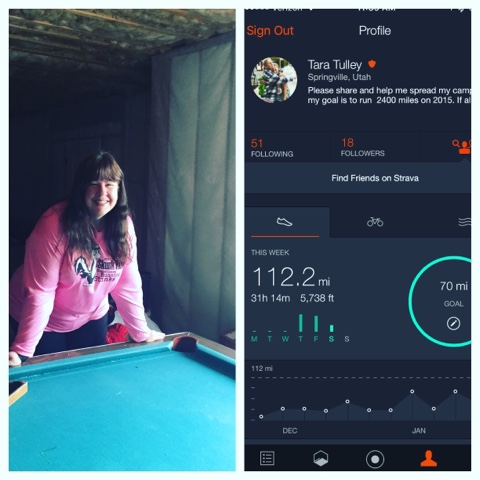
 After a short bath and 30 minutes of rest, I decided to run inside around my pool table until the air outside cleared a little. The air had started to hurt my lungs. I did that for about 7 miles, and during that 7 miles another friend, Cat showed up. As soon as she had to leave, around 112 miles another member of AIIA showed up with his wife blasting motivating music as he joined me for about 6-7 miles and she followed with her van the whole time cheering us on. My spirits were lifted and my speed increased dispite the fatigue my body felt. 


As I hit 120 miles Jeff and Callie came back and Christy Long showed up. We stared to trek up Hobble Creek canyon n when I made them stop and change directions and instead go into Mapleton. Andrea and Justin Garn joined us, and we set out to complete the last 19 miles.  I distracted myself by taking them to my childhood home, and we completed a half marathon circling East and South Mapleton before finally reaching home, and setting out for the last 7 miles.


Throughout the day my spirit overcame dispair and was replaced with hope, and by the last 7 miles a deep resolve set in, and I broke into a run. When I came around the corner, my neighbors Michelle and Keith Willmore, had set up a finish line and my husband,Jeff, and daughter, Helen,  Callie, and the Willmores were there cheering as I sprinted at full speed through the finish. 

Along the way, people heard the message and I am humbled by the response of strangers who have been touched and completed to donate to Addict II Athlete. 

I want to thank everyone who came out to support me. Just like recovery, a run like this is more successful with a support system. Without the team coming to walk with me, keeping my resolve would have been more difficult. 

To donated to AIIA and support the fight for mothers recovering from addiction please go to:

http://addicttoathlete.org/donate/

Sunday, August 2, 2015

Kat'cina Mosa 100k race report on DNF


Well, it looks like my finishing streak this year needed a humility check. Reminders that my body should be respected. This is my 7th year attempting Kat'cina, the furthest I've made it on this course is 46 miles. Yesterday I made it 30. 

Having POTS one thing I've learned is that I can never be unwilling to DNF if it is the right thing to do that day. My body has made marked improvements. I finished Squaw Peak this year, and Desert RATS a week apart from each other. 

The heat and grueling conditions at DR were tough on my body. I had an abscessed tooth that started at DR, and ended up with an impetigo infection on my face, not to mention all of the blistering my feet suffered from the heat and sand. I finished officially running in 100-106 temperatures, in barren slick-rock, and I was able to perform and manage POTS the whole time. 

Two days after finishing DR , I drove out to Jackson Hole for a family renunion, and flew out to the Postpartum Support International Conference to speak in Plymouth, Michagin, and ignored the tooth as much as possible because I just had to get through my commitments. 

Flying exacburates my POTS anyway, but having an infection also makes my symptoms worse. When I got home I was behind on work. The other issue was that my former dentist had recently closed his practice after surrendering his license, so I did not have a dentist anymore, and got through work with Tylenol until the pain became so severe, that it became a weekend emergency. 

When I was finally able to get into a dentist I found out the tooth was not only abscessed, but it had spread into my jaw. Thar was fixed a couple of weeks ago, but my energy had been super low, and I've been a little more Potsie the past couple of weeks. 

I'm on the mend, and I started the race at midnight because I knew I was more Potsie this week. I was very proactive at managing hydration, heat, and eating, but my body just didn't seem to have and rev yesterday. I struggled climbing Lightening Ridge, I think I still
Did it stronger and better than I have in years past. I started under a Blue Moon this year! 


But the climb up to Windy Pass I didn't handle as well as normal. A week before Squaw Peak, In June, I did that hike as a training run, overdressing on purpose, and much faster in preparation for DR. 

But yesterday it was just like all the life felt sucked out of me. I think, even though it was nearly 1pm when I reached Windy Pass Aid station, on a good day I could have busted my butt and made the Little Valley cut off, but it just didn't feel right. It wasn't like a normal exhaustion feeling, it was like my body was saying "I'm still on the mend, let me heal".

So I took a deep breath, and found I had cell service, about .25 of a mile before the aid station, and texted my coach my thoughts, that my body was telling me to rest today. I want to be strong, and fully ready for Wasatch 100 in September, my coach is making the effort to come pace me and help me finish Wasatch in September, I want to be able to give that race everything I've got. 

I believe I can finish Wasatch this year, I believe I could have pushed it yesterday and probably have warn myself down more, but it would have compromised my recovery for Wasatch.

So my coach agreed with my assessment, and I informed the aid that I would be walking back 5 miles to Big Springs with them. 

I took a nap on the mountain, I was very tired from starting at midnight. I felt better, and was amazed coming down with the three radio workers. They each carried 70+ lbs up the mountain, where running the radios and helping runners all day long, and then had to haul it all down on there backs. One of the guys was also carrying a solar panel in his hands and struggling without poles because he had to left his in order to carry the solar panel.

I felt bad for him and ended up trading him. I carried the solar panel so he could have my pulls to help him get those 70+ extra lbs down a steep trail, with a lot of loose rocks. 

I have a new respect for those radio guys, and anyone who is willing to work that aid station. Both Kat'cina Mosa and Squaw Peak would not be possible without those people willing to volunteer to run the Windy Pass aid station. Thank you to them and Addict II Athlete who took on that aid station for both Squaw Peak and Kat'cina this year! 


As we were hiking down, and I was carrying the guy's Goal0 solar panel, somehow the conversation led to me mentioning that my dad was the founder of Goal0. The other radio guy, lit up and asked me my dads name. I told him it was Robert Workman, and he got excited! He used to work for Provo Craft until shortly after my dad sold the company, and knew all about Tifie and Goal0 and even had gone to lunch with him and my brother Swan, when they were first developing the concept models for Barebonesliving.com

Small world, it was very fun for me to be able to hike down with the guys running the radio, and to see that side. I started to feel better after a nap, and going downhill, and the temperatures getting cooler, and by nightfall, I was thinking, "I Feel fine, why am I not running right now!" 

But I still feel like I made the right decision, and the fact that I woke up feeling energized, and my legs feel fresh and ready to run this morning is a good sign. I think my body is on the come back, I didn't even feel dehydrated last night or this morning.

I did a combo of drinking about 2x amounts water to of Normalyte solution. I also took about 3 gels per hour. I needed Zofran to help me get through the nausea of the hill climbing. 

I discovered near the top of a Windy that I needed to pull out my bacon jerky, almond, ginger-gummy candy mix I make for my runs, and probably should have been taking ages of those to two gels instead of straight gel per hour. 

It was a good chance to test my POTS nutrition theories for running Wasatch. I've been redining my nutrition/ hydration formula for racing this year. 

I think I got everything mostly right yesterday. The only thing I think I shpu have changed is adding in the fat and protein every hour in addition to the gels. If I intake fat and protein with gels my heart rate and breathing stay more regulated, especially for hill climbing. 

Kat'cina Mosa is the ultimate race to test this on, because the hills and trails of Kat'cina are tougher than Wasatch.
The climb to Francis peak at Wasatch feels like a walk in the park compared to the climbs to Lightening Ridge and Windy Pass at Kat'cina. Perhaps it is because I do this race four weeks before Wasatch and it helps me be in prime condition for the Wasatch climbs, but I really think the trails are more technical as well. 

The fact that the day after, I have few Potsie symptoms than the day before I did Kat'cina is a good sign that I'm getting good at understanding my nutrion needs and hydration needs.

This is the basic formula 

For every hour of activity, and during each hour 

1. Drink 4-8 ounce of Normalyte Solution (depending on the outside temperature and elevation), even in very hot temps the solution is high enough in sodium and potassium that more than 1/2 a litter is too much. I mix the power into two 16oz bottles. So one packet will last me 4-8 hours of activity. 

2. I take 2 hammer gels per hour. I hate the texture of gels, I have to wash them with water to not gag on the texture, but the formula hammer uses in their gels seems to work best for my body. 

3. Eat 10-15 almonds, a few peices of bacon jerky, and a few peices of ginger gummy candy. 

4. Drink water as needed, and I have to drink about 2x the ammout of water to the Normalyte mix to keep it balanced. 

5. I have a cooling, headltube clothe, this is essential for keeping more core temp down. 

6. I have a prescription for Zofran. Hillclimbing is more difficult with POTS,
In ways that it isn't difficult for other people. I'm more prone to stomach issues than other people when it's hot, steep hills, and I'm exhausted. Zofran allows me to keep eating and it reduces the other POTS symptoms when I can keep up with fluids and nutrition. 

7. Trail toes and Injinji socks= no blistering yesterday!


All in all it was a good experience, good training, and I woke up feeling refreshed and confident about Wasatch 100. 


Sunday, June 21, 2015

Desert RATS Multiday Stage Adventure Race

About three weeks ago, I received an email invitation from Lisa Smith-Batchen to participate in the 2015 Desert RATS stage race. A 143 mile race across 6 days of climbing desert mountains, sand, and in scorching hot temperatures. The conditions are so brutal that the race director proudly claims a finish rate of 50% or less.


I didn't think I was ready for this year. I said I would love to try it when I was in shape enough to complete it. Lisa wrote me back and told me I was in shape enough and I could finish. So I trusted my coach wouldn't lie to me, and I took a deep breath and signed up. I was instantly petrified.

I didn't know how much good it would do with only two weeks to train, but I started overdressing on my long runs, running in the hottest part of the day (already was running in the hot parts of the day, just not with extra clothing to simulate 100+ degree temperatures. 

Suddenly Squaw Peak 50 lost its focus and became a training run 1 were before DR. The week before I fretted, I read the racers manual 100 times. I was afraid of getting lost, I knew i couldn't afford to get lost because I wasn't fast enough to afford time losses, like some runners are.

It would be a true test of how much my body has really recovered from POTS to be exposed to the sun and heat for several hours every day. I was a little nervous to go talk to my Doctor about needing medical clarance for a race in the heat, and he did question my sanity but agreed to clear me after a discussion on how I know my body and don't ever push myself to the point of becoming a medical liability. I always stop if I really don't feel like my body is working properly. 

I showed up at the pre-race meeting on Sunday June 14th, I gave my medical profile to the staff Doctor and he told me he has never seen anyone with POTS who was well controlled, but I confidential ly stated that I was and had been working on it for 5 years. 

Sunday night my stomach was all in knots, I didn't sleep well, something was different in me with this race. I wanted to prove to myself that I could finish, a hot race, all of the worse possible factors working against a person with dysautonomia, all of the elements for failure were stacked against me, and I wanted to beat all of them in a way that I've never cared about before. I wanted to finish this race officially, and within all the time limits. 

Day 1- after getting up at 3:30 am and getting totally ready to run because I was too nervous to sleep I was able to finally fall asleep from 4:30-6:30am. At 7:30
I arrived in front of the Gonzo Inn, in Moab where two fellow Dreamchasers Traci and Sada were also waiting. We loaded the vans, and headed out to Loma Utah to the start of the Kokopelli Trailhead. Fearing that any mistake would cost me the race, I was grateful to have loaded a map app with the route into my phone that proved to keep me from going off the course several times. 

Day one started at 10 am with temperatures in the high 90's. The first day we completed just under 20 miles, and I came in 5th for women and 7th overall, out of 16 who started the race. That blew me away because since I've struggled with POTS its effected my speed, and I didn't realize how much I really have improved and how much my hard training this year has paid off. I finished stage one in 5:44- 1:46 ahead of the cuttoff time. 

Day 2- we went about 35 miles and temperatures reached 100 degrees. This was a difficult day because the heat was unrelenting. I worked hard and with the help of some anti-nausea medicine was able to overcome the effects of heat and sub on my body long enough to reach mile 29 in just 8 hours. However,
At mile 29 I was overheated and sick and had to stop for over 45 minutes to recover, and then I had to take the last 6 miles very slowly finishing stage two in 11:09- 1:21 ahead of the cuttoff times.

Day 3- we had a by of a break, we ran a short 12 mile section, I started the first two miles walking slowly and then decided I needed to pick it up to finish faster to get out of the sun. It was a hilly trail section, and I finished in 3:17- 1:43 ahead of the cuttoff


Day 4- became the true testing ground for me, we had nearly 43 miles to complete over very hot, and steep mountain climbs into some of the toughest technical trail sections of the course. It was over 30 miles of climbing and only about 13 decent. The first 12 miles were tough but I felt OK, and then it started to get hot, I believe it probably hit close to 110 degrees on some of the sections. After mile 18, there was a long 2000 foot accent section, with no water drops or aid. I ran out of water about 8 miles into that section and it was still over 100 degrees out, it was a very slow and painful 4 miles until I was able to get to the next aid station around 7:30pm, in order to remain official I needed to complete the stage by midnight. With 4:30 hours left, after rehydrating and being able to eat again my energy came back and I pushed out a strong 12.5 mile section to finish stage three in 16:45- just 15 minutes ahead of the cuttoff times 

Stage 4 was so difficult on my body that I had severe muscle cramps from dehydration and heat sickness all night, and developed a bacterial infection on my face.

Day 5- The next day was a recovery day which I spent rehydrating, correcting my eletrolyte depletion, and wading my legs and feet in the cold water. I also was started by the camp doctor on a course of antibiotics to fight the infection. I could barely walk, yet still had one marathon to run the next day to compete the race. The medical team fixed up my feet, and for the first night of the whole event I was able to sleep well. 

Day 6- I woke up feeling much better and we started the race in waves. I started at 7:30 am, and climbed the first 6.5 miles of the course (over 1500 feet of gain) in under two hours. From there I started the downhill decent and my sore feet started to calm down. I went from hobbling a 15-6 minute mile to being able to tolerate a 12-13 minute mile consistently down until I got to the technical trail out-and-back from miles 15-19.5 to Porcinine Rim. This section was long, hot and difficult, and slow. But after completing the trail section instarted the last 6.5 mile downhill section on road and was able to keep about a 12.5 minute mile pace and the last two miles a 8-10
Minute mile pace to finish the stage in 7:29- 1:01 ahead of the cuttoff time.

As I crossed the finish line the emotion of what I had just done overcame me. There were times on stage 4 that I was sure I would not be able to get the cuttoff, and then something deep inside would rebel and I would find it somewhere to push faster and stronger, and committed to be at the finish by midnight no matter what. 

Only 6 of the 16 who started were able to finish as official finishers, placing me as the 4th place female. However, the unofficial finishers were just as impressive, some of them being eliminated early on, went on to give it all they had and covered the same distance without the motivation of official completion. That was truely impressive to watch. 


Today I am recovering and humbled at the strength I have regained through a lot of medical and physical support, and spiritual guidance and healing. I'm very humbled by what I was able to do this week. Inhale to thank my coach, family, friends, and many wonderful care providers who have helped me along the way, and God for making healing possible. 

Every one of the names on the list above proved to be some of the most courageous people I've ever met. Everyone of them struggled and gave it all they had. The odds were stacked against all of us, and we all showed up and gave it what we had. There is nothing to be ashamed about giving it your all no matter what the results are. 

Looking forward to a week off from running this week.